Dear Friends of the Jewellery- Linking Bodies department,
It is this time of the year again!
We are happy and proud to present our graduating student of 2024:
Martina Bucci
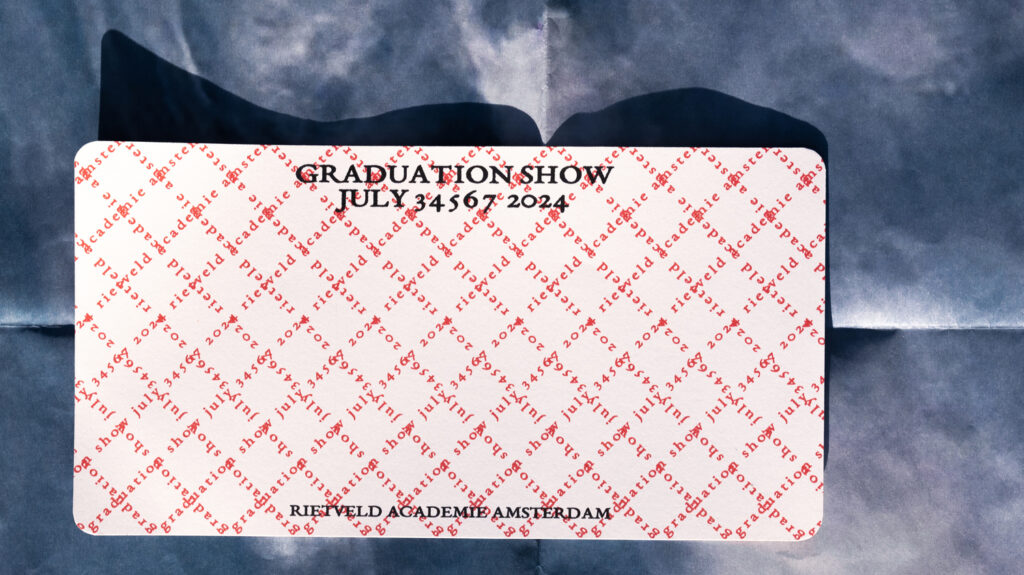
This year’s graduation is extraordinary with Martina presenting her work and representing the Jewellery – Linking Bodies department at the Rietveld Pavilion.
Martina investigates in detail what puts us into relation. Her collective jewellery pieces can be considered intimate and fragile objects related to the body, offering explorations and encouraging social interactions.
We look forward to welcoming you at the pavilion, amongst an exciting show presenting the graduates of 2024
We look forward to welcoming you at the academy for the last and celebratory event of this academic year! In the meantime, please take a look at all the projects, lectures, research and exciting events we held throughout the year and our archive dating all the way back to 1968 on this website.
Warmest regards, Jewellery- Linking Bodies Department
Campaign by Graphic Design graduates Haoran Zhi and Anna Reymond
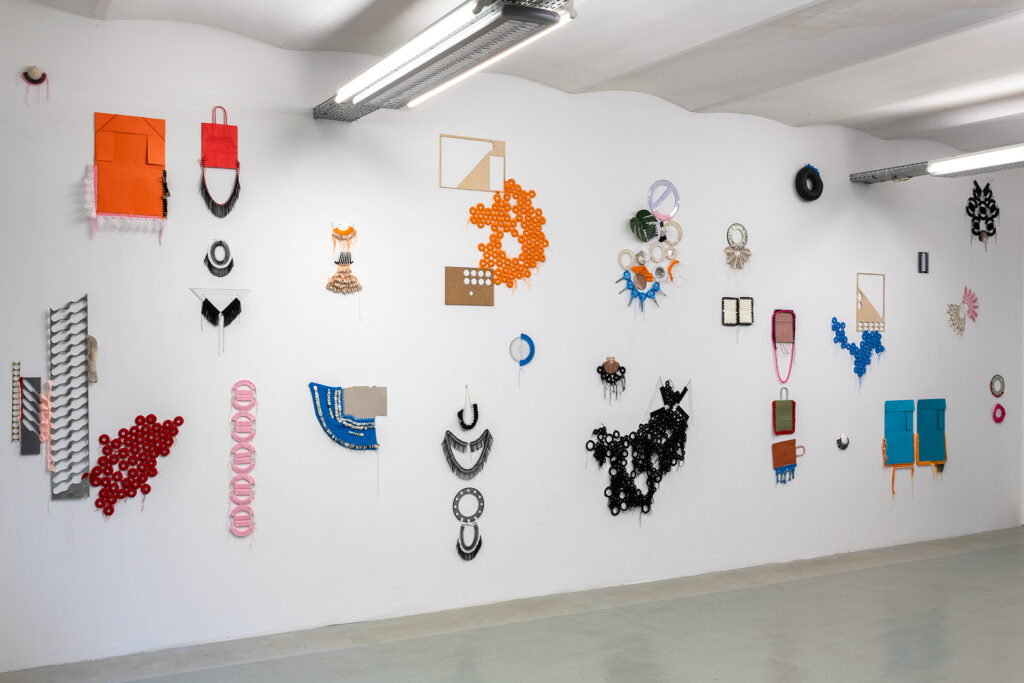
Through forty images, Silvana Mc Nulty will share the evolution of her practice, her process and her position as an artist in the art world. She works mainly with textile technics, such as crochet, that she mingles with different objects. Each piece she creates is often of a small scale, allowing her to work wherever she is and offering her flexibility and autonomy. It is through accumulation and association that the scale changes adapting to the exhibition space. Questions of installation are therefore inherent to her work.
Bio: Silvana Mc Nulty (born in 1995, lives and works in Paris) is a French artist. Her practice lies at the intersection of sculpture, object, jewellery and textile. She places raw material at the center of her research. Through her practice of weaving and patchwork, organic and artificial confront and mingle. She creates objects that are both flexible and unstable whose hybrid status rises confusion. Her work has been exhibited at In Extenso (Clermont-Ferrand), Le Creux de l’Enfer (Thiers), Treize (Paris) and the Florence Loewy gallery (Paris), which represents her. https://www.silvanamcnulty.com/
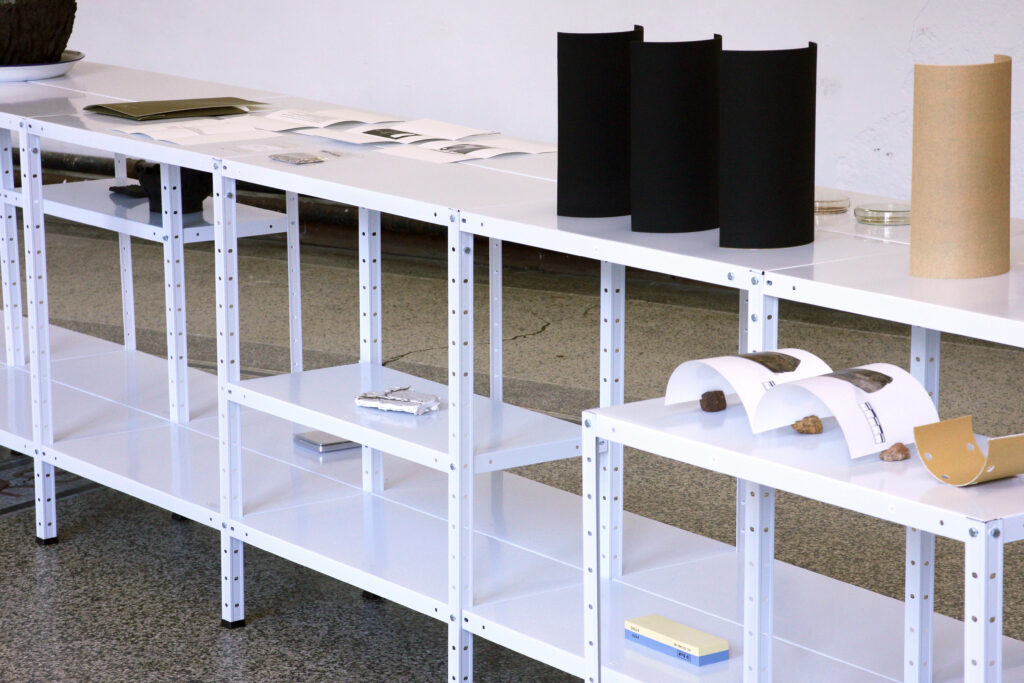
Irma Földényi and Saskia Van der Gucht will present Sandscapes (2023). They will give an introduction on their practices and their collaboration in artistic research where they look at the topic of ecology through precious mined materials.
Sand is a granular material composed of finely divided rock and mineral particles. After water it is the most utilized natural resource on earth. It is present in every structure, road, window, and screen we use daily. As abundant as it seems, it is predicted to become scarce due to overconsumption by industrial use.
‘Sandscapes’ was an exhibition at Kunsthal Extra City in Antwerp, Belgium by Saskia Van der Gucht, Irma Földényi, Eline de Clercq and Virág Szálas-Motesiczky. It presented a case study on sand, its finitude and preciousness through four perspectives.
This collaborative artistic research was a result of ‘an invitation to think with us’ – from Irma and Saskia to Virág and Eline – to test their research around the central question: How would you translate finitude through your practice?
Their fieldwork spanned across contexts of an archeological site, a construction project, hardware stores and a gem laboratory, looking at ways of connecting specific locations, theory readings, material samples and experiments. The presentation shared physical outcomes of the four participants, curated over scale, referring to the gradualness between a piece of land and a grain of sand.
Sandscapes, 2023
Bio: Saskia Van der Gucht (BE) is a visual artist, researcher and teacher based in Antwerp. Her work deals with the complexities and ecologies of emotional and economic value of materials and the feeling of home. Through a combination of references to jewellery and architecture, she translates these subjects into objects, small installations, photography and drawing.
In 2014 she obtained an MA in Jewellery Design at Sint Lucas Antwerp. Currently she is enrolled in the Advanced Master program on research in Art & Design in a socio-political context. Since 2019 she has been teaching the theory course ‘Art & design in the anthropocene’ together with Irma Földényi. From 2017 to 2022 she was a teacher at the jewellery department, both at Sint Lucas Antwerp. https://www.saskiavandergucht.be/
Bio: In her practice Irma Földényi (HU/NL) brings together outcomes from her ongoing, often collaborative research into the sourcing and valuing of materials, and the possible roles of the jeweller within contemporary material discourse. It seems important to try to understand where and how materials enter our lives and to question the construction of their value, but complex supply chains and industrial processing often obscure any connection to a material’s origin. By giving form to context, she aims to reveal nuanced stories from our geological era. The outcomes are designed not to draw attention to themselves as primarily precious jewellery objects but to communicate their connections to broader fields — whether historical, geographical, ecological or otherwise. https://studio-if.nl/studio/
Irma has been teaching at the Design Academy Eindhoven, Gerrit Rietveld Academy Jewellery – Linking Bodies and Sint Lucas Antwerpen Jewellery Department. She is currently developing her PhD ‘Voices of Materials’ at Sint Lucas Antwerpen & University of Antwerpen, and is a board member of the Francoise van den Bosch Foundation, which aims to stimulate and promote contemporary jewellery.
We look forward to welcome Irma, Saskia and Silvana!